Cruise operators have made significant strides in energy efficiency over the past decade. Engine room monitoring, shore power connections, and LED retrofits have become standard practice. HVAC systems, however, remain an area where most vessels still operate well below their technical potential.
Air handling units account for roughly 35% of HVAC energy consumption, and field tests show that 10-12% of that energy can be recovered through optimization. Unlike hardware upgrades that require dry-docking and capital investment, AHU optimization works with existing equipment. The efficiency gains are available now, on vessels already in operation.
Why AHU efficiency affects the entire HVAC system
Chillers respond to cooling demand, and that demand comes primarily from the AHUs. When an AHU delivers more cooling than a space requires, the chiller plant works harder to meet that demand. Optimizing AHU operation therefore has a multiplier effect: it reduces fan energy directly while also lowering the load on chillers.
Our field data suggests roughly equal savings potential from AHU and chiller optimization, approximately 50/50 when both systems are addressed together. This interdependence means the two systems benefit from coordinated control. Allowing chilled water temperatures to rise while simultaneously ensuring AHUs don’t create artificial demand captures efficiency that neither system can achieve alone.
AHU optimization has a multiplier effect: it reduces fan energy directly while also lowering the load on chillers.
New ships, old settings
Modern cruise ships already have capable HVAC hardware. Variable frequency drives, CO₂ sensors, and zone-based controls are increasingly common. The remaining efficiency gains are not in the equipment itself, but in how it responds to changing conditions.
Four patterns account for most of the recoverable energy:
- Conservative setpoints
AHUs are configured for peak conditions that occur perhaps 10-15% of operating time. The cube law makes the penalty steep: a fan running at 70% speed when 45% would suffice uses significantly more power than necessary. Dynamic setpoint management recovers this margin without compromising comfort. - Underutilized CO₂ controls
Many vessels have CO₂-based ventilation controls that could modulate airflow based on occupancy. These systems often run with minimum speeds set high enough that the CO₂ response never engages. Recalibrating these thresholds unlocks capacity that’s already installed. - Schedule gaps
Hotel operations data rarely reaches HVAC controls. Restaurants, theaters, and conference rooms are conditioned uniformly regardless of their activity schedule. Connecting HVAC to hotel operations allows AHUs to anticipate demand rather than run continuously. - Knowledge transfer between crews
HVAC engineers rotate every few months. Optimization settings that work well can drift as crews change. Capturing effective configurations in software preserves institutional knowledge across rotations.
How AHU optimization works
For AHU optimization, cruise operators require several capabilities that extend beyond standard automation.
Optimization requires visibility into each unit’s operation: energy consumption, fan speed, supply and return temperatures, pressure, CO₂ levels, and valve positions. This data must be collected continuously. A theater empties in 15 minutes, a restaurant fills over 30 minutes. Systems that sample hourly miss these transitions.
The system must modulate fan speeds, reset supply air temperatures, adjust pressure setpoints, and change recirculation ratios automatically in response to changing conditions. Even skilled engineers cannot respond quickly enough to capture every transient opportunity.
Ultimately, the most significant opportunities come from knowing what’s happening on the ship. A theater can run at minimal conditioning when the system knows the next show starts in four hours. Port days, when most passengers are ashore, allow public space AHUs to operate at reduced levels while cabin areas maintain full comfort. Regulated spaces like galleys and medical facilities require separate treatment, maintaining required ventilation minimums regardless of optimization elsewhere.
This is exactly the gap Arkitech was built to close. Manual tuning can’t keep up with this complexity. Closing the gap requires a system that monitors every space continuously and acts in real time.
A theater empties in 15 minutes, a restaurant fills over 30 minutes. Systems that sample hourly miss these transitions.
From monitoring to action
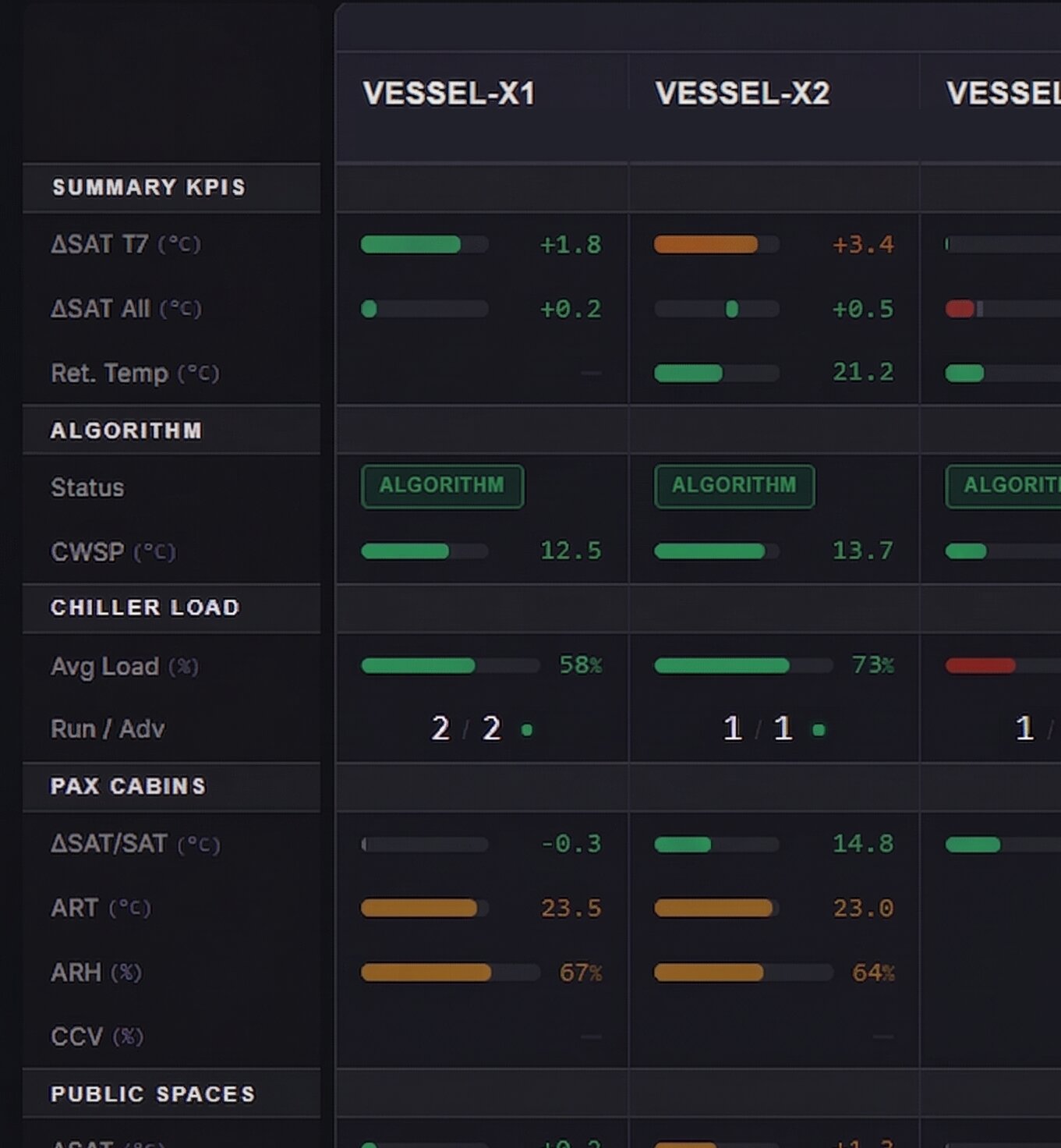
Arkitech’s HVAC optimization system interfaces with existing vessel automation through an onboard edge computer, requiring no modifications to individual AHU controllers. The system maps each AHU to its served space and applies space-specific optimization that respects regulatory requirements while capturing savings where flexibility exists. For technical specifications and deployment details, see our solution page.
Proven at sea
FAQ
-
Large cruise vessels have 65 to 100 air handling units serving distinct zones: passenger cabins, public venues, crew areas, galleys, and operational spaces. Each unit operates under different demand profiles, which is why optimization must be space-specific.
-
At berth, propulsion loads drop to zero but HVAC keeps running, making chiller optimization even more impactful as a share of total energy. On sea days, conditions shift with weather, speed, and occupancy patterns throughout the day.
-
The system monitors CO2, temperature, and humidity continuously. If reducing fan speed would push CO2 above acceptable levels, the reduction does not happen. Regulated spaces like galleys and medical facilities maintain required ventilation minimums regardless of optimization elsewhere.
-
Galleys, medical facilities, and other regulated spaces are flagged during the initial system mapping. These zones maintain their mandatory ventilation rates at all times. Optimization is applied only to spaces where flexibility exists, such as restaurants, theaters, and public areas outside of active use.