Opportunity in the margins
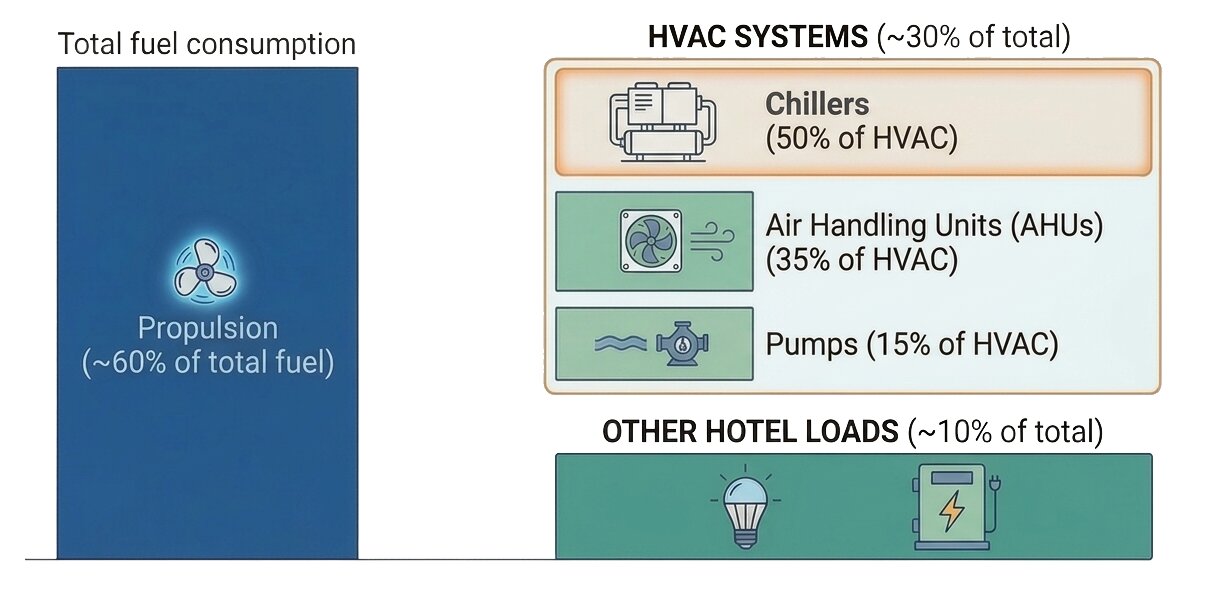
The gap between peak design conditions and everyday operations is where the savings sit. How much room there is depends on variables that shift continuously: seawater temperature, outside air temperature and humidity, zone occupancy and thermal load, and time of day combined with upcoming weather.
A Caribbean-to-Northern Europe routing alone can see seawater temperatures swing by 25°C or more, where each degree changes how hard the condenser works. Chilled water temperatures can often be raised safely, but only as far as humidity control permits.
Most crews manage this complexity with conservative defaults: settings that work reliably across seasons, routes, and crew rotations. That is a rational approach; it avoids comfort complaints, protects equipment, and transfers safely between teams. But it also means the plant consistently runs with wider margins than conditions require.
The gap between peak design conditions and everyday operations is where the savings sit.
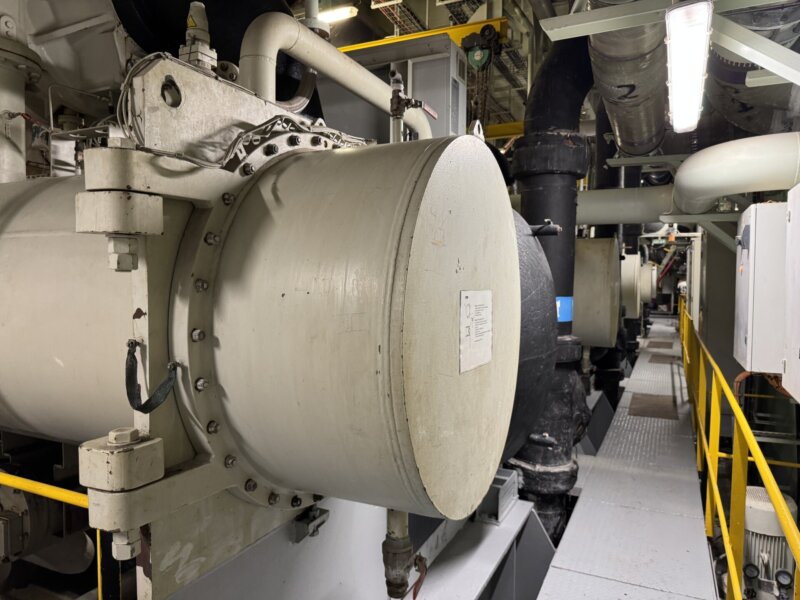
Four key optimization areas for chillers
Capturing those margins requires looking beyond the engine control room. Most of the recoverable energy emerges from the interaction between the variables above, minute by minute. These are four areas where the largest gains are available:
- Dynamic setpoint management
The largest single opportunity. On most voyages, chilled water temperatures can be raised without compromising comfort or humidity control, but knowing when and how far requires continuous monitoring of zone temperatures, humidity, weather, and chiller performance. The goal is maintaining comfort at the highest safe setpoint at any given moment. - Chiller sequencing and load balancing
Vessels with multiple chillers face constant sequencing decisions. Running one chiller at 80% load is typically more efficient than two at 40%, but the right strategy depends on each unit’s current performance and the load profile. Poor sequencing pushes chillers into inefficient operating ranges; intelligent load balancing keeps each unit in its optimal zone. - Coordination with air handling units
Chillers respond to whatever air handling units (AHUs) demand. Units running at fixed speeds in unoccupied spaces create artificial chiller load, a cost the plant absorbs invisibly. Coordinating AHU and chiller optimization addresses demand at the source rather than just managing it at the plant. - Pump optimization
Chilled water pumps often run with excessive safety margins. Because pump power follows the cube law, even modest speed reductions yield significant savings; a 20% reduction in flow cuts pump power by roughly 50%.
Managing these four areas independently is possible. Capturing the interaction between them is not — that requires a system that sees everything at once.
Arkitech’s is an onboard edge computer that interfaces with the vessel’s existing automation, not directly with individual chiller controllers. This allows integration across equipment from different manufacturers without hardware modifications. By processing real-time variables including weather, seawater temperature, and occupancy, the system replaces static setpoints with predictive orchestration that synchronizes chillers, AHUs, and pumps as a coordinated network.
AHU optimization has a multiplier effect: it reduces fan energy directly while also lowering the load on chillers.
FAQ
-
Large cruise vessels have 65 to 100 air handling units serving distinct zones: passenger cabins, public venues, crew areas, galleys, and operational spaces. Each unit operates under different demand profiles, which is why optimization must be space-specific.
-
At berth, propulsion loads drop to zero but HVAC keeps running, making chiller optimization even more impactful as a share of total energy. On sea days, conditions shift with weather, speed, and occupancy patterns throughout the day.
-
The system monitors CO2, temperature, and humidity continuously. If reducing fan speed would push CO2 above acceptable levels, the reduction does not happen. Regulated spaces like galleys and medical facilities maintain required ventilation minimums regardless of optimization elsewhere.
-
Galleys, medical facilities, and other regulated spaces are flagged during the initial system mapping. These zones maintain their mandatory ventilation rates at all times. Optimization is applied only to spaces where flexibility exists, such as restaurants, theaters, and public areas outside of active use.
Proven at sea
Why this matters now
These efficiency gains have a commercial case that stands on its own. Tightening maritime regulation, from IMO CII requirements to regional frameworks like EU ETS and Fuel EU Maritime, adds further urgency. We cover these regulations and their impact on HVAC in our decarbonization article.