Cruise operators have more options than ever to reduce fuel consumption and emissions, but not every measure delivers results on the same timeline. And with regulations tightening on a fixed schedule, that timeline is what matters now.
The cruise industry has largely focused on future solutions: alternative fuels, next-generation propulsion, newbuilds designed around tighter standards. These will be necessary, but the fleet that must meet today’s targets already exists. Hundreds of vessels currently in operation need to stay competitive and compliant for the next fifteen to twenty years. For these ships, the fastest path to decarbonization runs through the systems already on board.
Every fleet operator is therefore weighing similar questions:
- Which ships should be upgraded and which are approaching end of commercial life?
- Which technologies carry the least risk for the investment required?
- How do you improve emissions performance without taking vessels out of service?
- How do you avoid stranded assets as the regulatory bar keeps rising?
"Hundreds of currently operating cruise vessels need to stay competitive for the next 15-20 years. For them, the fastest path to decarbonization runs through the systems already on board."
Carbon Intensity Indicator
The IMO’s Carbon Intensity Indicator (CII) rates every vessel above 5,000 GT on its annual CO2 emissions per unit of transport work, from A (best) to E (worst). Ships rated D for three consecutive years or E in any single year must submit a corrective action plan. As of April 2025, reduction targets have been confirmed through 2030, requiring a 21.5% improvement relative to 2019 levels.
Several factors make this especially pressing for the cruise industry:
- The CII rating tightens every year: A vessel that scores C today drifts into D without any change in operations.
- Direct carbon costs: the EU ETS now covers maritime transport at $80 to $85 per ton of CO2, turning every ton of fuel burned into a direct expense. Financiers and charterers are differentiating on carbon performance.
- The cruise penalty: the CII was designed for cargo vessels and does not account for the constant hotel loads or frequent port calls that define cruise operations. Cruise-specific modeling shows individual vessels reaching rating E as early as 2029.
A 2022 predictive analysis by vessel segment confirmed this: cruise ships were among the worst-positioned categories, with the majority falling into D and E if no action is taken. The first actual IMO data, covering roughly 25,000 ships in 2023, showed 22% already rated D or E across the global fleet.
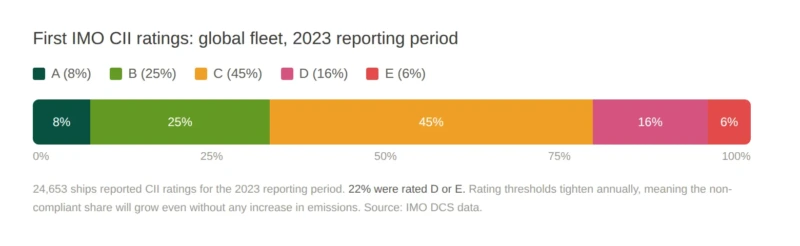
CII applies globally, but operators calling at EU or US ports face additional regulations that compound the pressure.
CII is not static: today’s C becomes tomorrow’s D
Energy Efficiency Existing Ship Index (EEXI)
Alongside CII, the IMO introduced a second measure for existing ships: the Energy Efficiency Existing Ship Index (EEXI), in force since January 2023 for vessels above 400 GT. Unlike CII, EEXI is a one-time technical ceiling on the ship’s design — its calculated CO2 per transport unit must stay below a defined reference value.
Most existing cruise vessels have already cleared EEXI, typically through Engine Power Limitation (EPL): a software cap on maximum engine output. EPL satisfies the index, but it does not reduce actual fuel consumption at normal operating loads, and therefore does nothing for the CII rating. The result is that a vessel can be fully EEXI-compliant and still drift toward a D or E rating under CII. Closing that gap requires measures that lower real onboard consumption — which is what the rest of this article is about.
Multiple regulations are converging into one operational reality
- EU ETS for maritime
Companies must surrender emission allowances for 40% of 2024 emissions, 70% of 2025 emissions, and 100% from 2027 onward. From 2026, the scope expands beyond CO2 to include methane and nitrous oxide. Every ton of fuel saved translates directly into avoided allowance purchases. - FuelEU Maritime / Shore Power
FuelEU Maritime (effective January 2025) mandates progressive reductions in the greenhouse gas intensity of energy used onboard, assessed on a well-to-wake basis. From 2030, the EU Shore Power Mandate will require all passenger ships to connect to shore power when berthed for more than two hours at Trans-European Network ports. - F-Gas regulations
The EU F-Gas Regulation (2024/573) and the US AIM Act are both accelerating the phase-down of HFC refrigerants used in chiller systems. High-GWP refrigerants are becoming scarcer and mor* e expensive on both continents. The US AIM Act mandates an 85% reduction in HFC production by 2036, while the EU has banned servicing with virgin high-GWP refrigerants from 2025. Optimizing chiller systems extends equipment life and reduces servicing needs, delaying capital-intensive replacements.
Every ton of fuel saved translates directly into avoided allowance purchases.
How operators are responding
The main question is which measures can deliver results before the compliance windows close. Available options range from capital-intensive measures requiring dry-docking, to operational adjustments that can be deployed without taking a vessel out of service. The challenge is that the highest-impact hardware measures also require the most lead time, and that timeline is often misaligned with the pressure of annual CII cycles and rising carbon and energy costs.
The table below compares the several common improvement measures: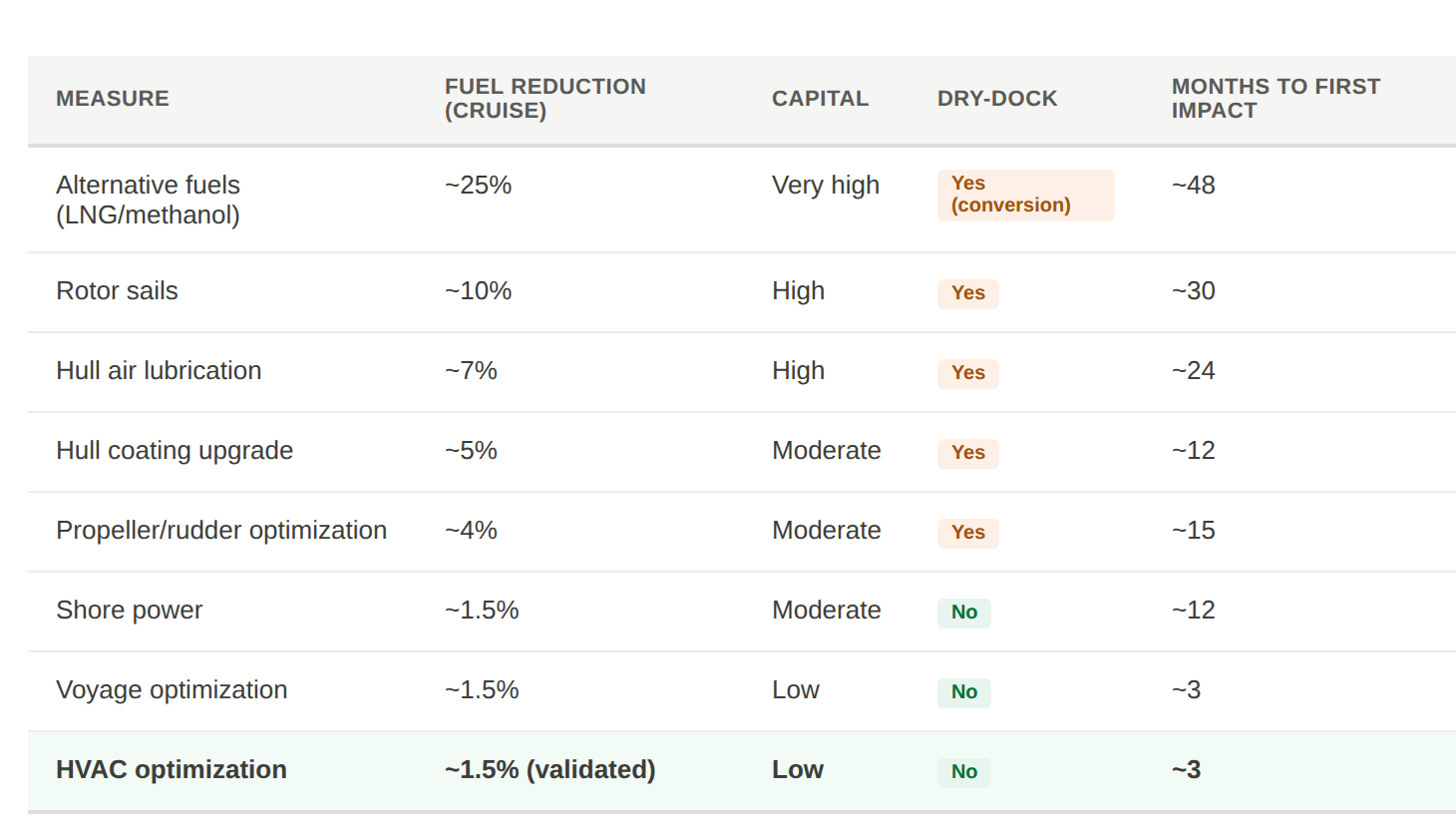
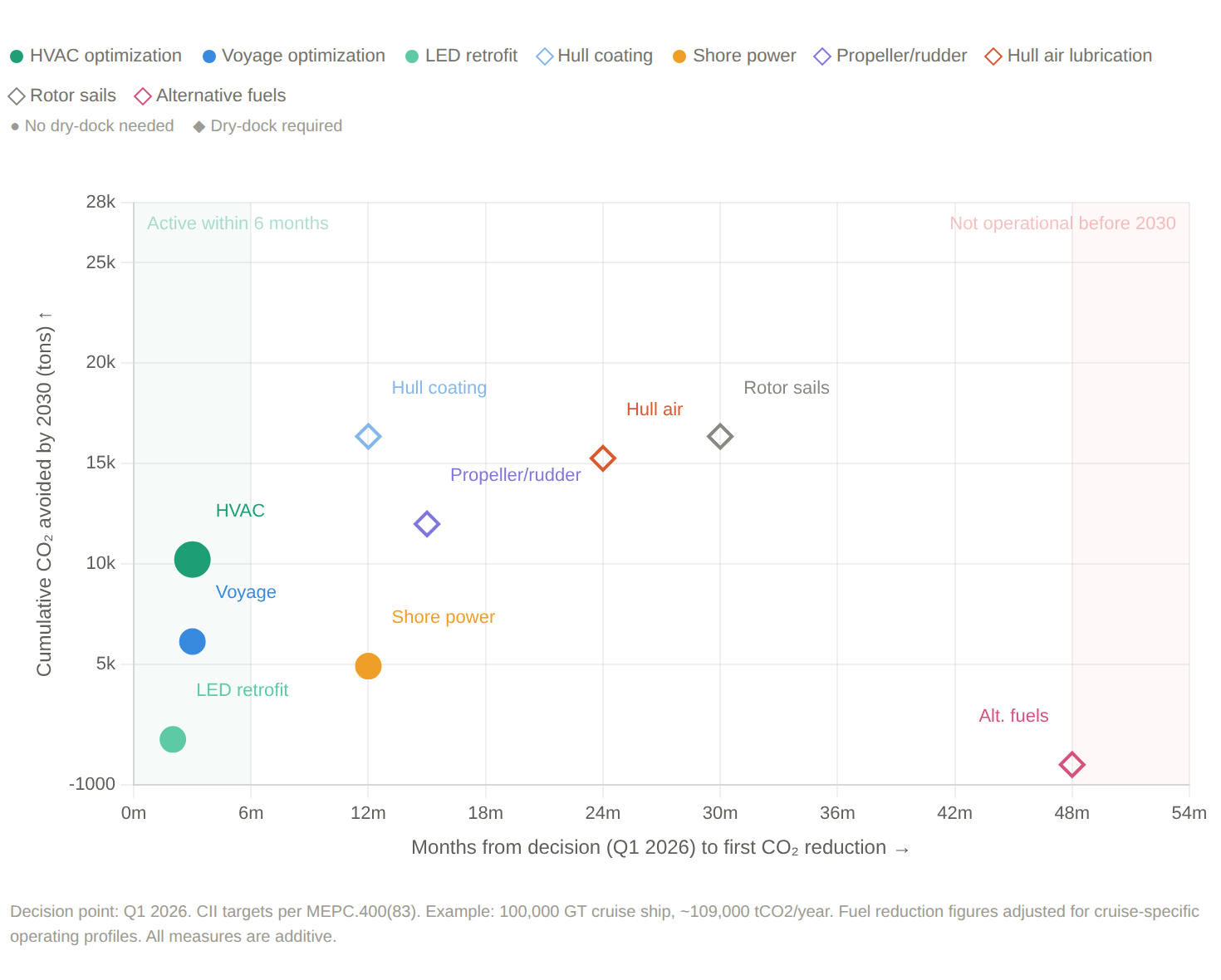
Hardware upgrades like alternative fuels, rotor sails, and hull air lubrication are essential for meeting targets beyond 2030, but their lead times mean the first CO2 reductions are still years away. In the meantime, CII ratings continue to tighten annually and EU ETS costs apply to every ton of fuel burned from 2027 onward.
Operational measures like HVAC optimization, voyage optimization, and hull coatings at the next scheduled dry-dock can be deployed within months. They reduce emissions and costs immediately, buying time and funding headroom while larger capital projects are planned and executed.
These measures are all additive, and most operators will need a combination of structural investments for the long term and operational measures that limit exposure in the years directly ahead.
The chart below puts this trade-off in perspective, and plots each measure by how quickly it can start delivering CO2 reductions against its cumulative impact by 2030.
Which measures can deliver results before the compliance windows close
HVAC optimization
Our ARK-M20 system interfaces with existing vessel automation through an onboard edge computer, requiring no modifications to individual PLCs or the existing automation. By processing real-time data from thousands of variables including inside conditions, outside conditions and occupancy, the system replaces static setpoints with predictive orchestration.
Deployments across multiple vessel classes show consistent HVAC energy reductions up to 10%, translating to approximately 1.5% fuel and 1,000 tons of CO2 avoided per vessel per year. For vessels currently rated C, this extends CII compliance by up to one year, buying time to plan and execute larger interventions.
Control energy usage at fleet level with precision and transparency

FAQ
-
Yes. It is additive. Operators pursuing voyage optimization, shore power, hull modifications, or alternative fuels see cumulative benefits when HVAC optimization is layered on top.
-
Hotel loads contribute to carbon intensity continuously, so every kilowatt-hour saved is reflected in the annual CII calculation from day one. Operators typically see measurable improvement within the first reporting period after deployment.
-
Shore power eliminates auxiliary generator emissions in port, but the HVAC system still runs on that power. Optimizing HVAC reduces shore power consumption and its associated costs. At sea, where shore power is not available, HVAC optimization delivers its full fuel savings independently.
-
Advanced hardware is only as effective as the logic controlling it. Even vessels with VFDs often run inefficiently due to manual setpoint management and conservative safety margins. The ARK-M20 synchronizes this hardware with real-time demand to capture the final 5 to 15% of latent efficiency.
-
The system is installed while the vessel remains in service. No dry-docking is required, and no physical modifications are made to existing HVAC machinery. Installation is completed in coordination with the ship’s engineering team, with savings typically measurable within two to three months.
-
Performance is tracked through continuous monitoring of HVAC energy consumption, broken down by chillers, AHUs, and pumps. Calculation methodologies are undergoing independent audit by DNV and Bureau Veritas to provide third-party validation.
Arkitech has allowed us to reduce HVAC energy by up to 10%
Arkitech has allowed us to reduce HVAC energy consumption by up to 10% on the vessels where it is deployed, without affecting passenger comfort or operational reliability. For us, the value is twofold: immediate fuel savings and a tool that helps us and our onboard teams manage HVAC performance more consistently across the fleet.
Stefano Aiello, Energy Efficiency Manager at MSC Cruises