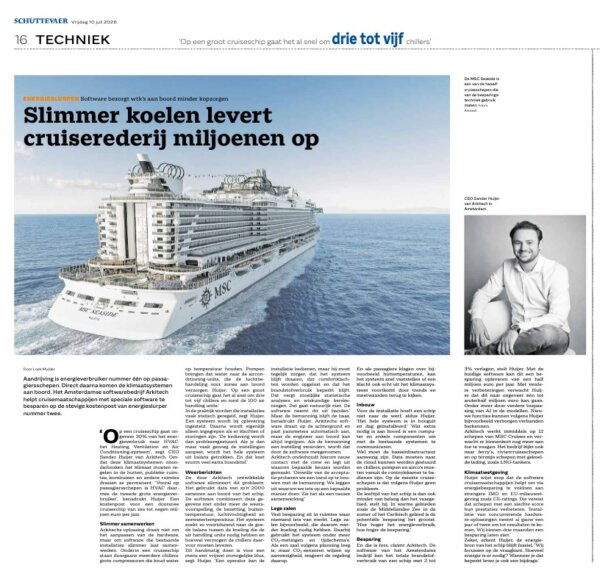
Smarter Cooling Saves Cruise Lines Millions
By Loek Mulder | Amsterdam | July 11, 2026
Propulsion is the largest energy consumer on passenger ships, followed by the climate-control systems on board. Amsterdam-based software company Arkitech helps cruise lines cut the substantial cost of this second-largest energy user with purpose-built optimization software.
“On a cruise ship, about 30% of total energy consumption goes to HVAC – the heating, ventilation, and air-conditioning system,” says Arkitech CEO Sander Huijer. Because these systems must continuously regulate conditions in cabins, public areas, galleys, and other spaces, they operate around the clock. “That makes HVAC the second-largest energy consumer, especially on passenger ships,” Huijer emphasizes. For a typical cruise ship, it represents an annual expense of €6 million to €9 million.
Smarter Coordination
Arkitech’s solution does not involve modifying the hardware. Instead, its software enables existing equipment to work together more intelligently. Several chillers are typically located deep inside a cruise ship. These large compressors keep chilled water at the required temperature. Pumps circulate the water to air-handling units, which condition the air in different zones throughout the vessel. “A large cruise ship can easily have three to five chillers and roughly 100 air-handling units,” Huijer says.
In practice, these systems are often controlled using static settings, Huijer explains. The system is configured when the ship is commissioned, and after that, adjustments are generally made only when complaints or malfunctions occur. “Operation then becomes reactive. If settings are changed often enough, the entire system is thrown out of balance – and that requires an enormous amount of extra fuel.”
Weather Forecasts
Arkitech’s software eliminates this problem by using data from approximately 2,000 sensors on board. It combines those readings with information such as weather forecasts, occupancy, outdoor temperature, humidity, and seawater temperature. The system continuously finds the right balance between the cooling required by the air-handling units and the amount of power the chillers need to provide.
Doing this manually is virtually impossible, Huijer says. “An operator can run the system, but at the same time has to keep it operating, resolve comfort complaints, and minimize fuel consumption. That requires complex statistical analysis and mathematical calculations. A person simply cannot do all of that. The software takes over that work.”
The crew remains in control, however, Huijer stresses. Arkitech’s software runs in the background and automatically adjusts parameters, but the ship’s engineer can intervene at any time. If the crew changes a setting, the software incorporates that change.
To support that collaboration, Arkitech stays in close contact with the crew and explains why certain decisions are made. “To encourage adoption, we try to build a relationship with the crew. We explain why we do things a particular way. Think of it as a close collaboration.”
Empty Venues
Much of the energy savings comes from spaces where no one will notice a difference – for example, empty venues that require less cooling. The system uses CO₂ readings and schedules, among other data. If a venue is scheduled to be empty but CO₂ sensors indicate that people are present, the controls respond accordingly.
When passengers report issues such as cabin temperatures, the system can also quickly determine whether the complaint is actually related to the climate-control system by reviewing historical trends and sensor data.
Installation
A ship does not need to go to a shipyard for installation, according to Huijer. “The entire system can be installed in no more than a day.” The only additional equipment required on board is a computer and several components that allow the software to communicate with the existing systems.
The vessel does need to have the basic infrastructure in place. Data must be transferable to the cloud, and the chillers, pumps, and air-conditioning systems must be controllable from the control room. According to Huijer, this is not a problem on most cruise ships.
The vessel’s age is therefore less important than its operating region, he says. The potential savings are greatest in warm areas such as the Mediterranean in summer or the Caribbean. “The higher the energy consumption, the greater the savings.”
Savings
And those savings are substantial, Arkitech says. According to Huijer, the Amsterdam-based company’s software can reduce a ship’s total fuel consumption by 2% to 3%. With the software in its current form, that can amount to approximately €500,000 in annual savings. Huijer expects further improvements to increase that figure to roughly €1 million to €1.5 million, in part through broader use of AI in the models. New capabilities could, for example, identify hidden relationships.
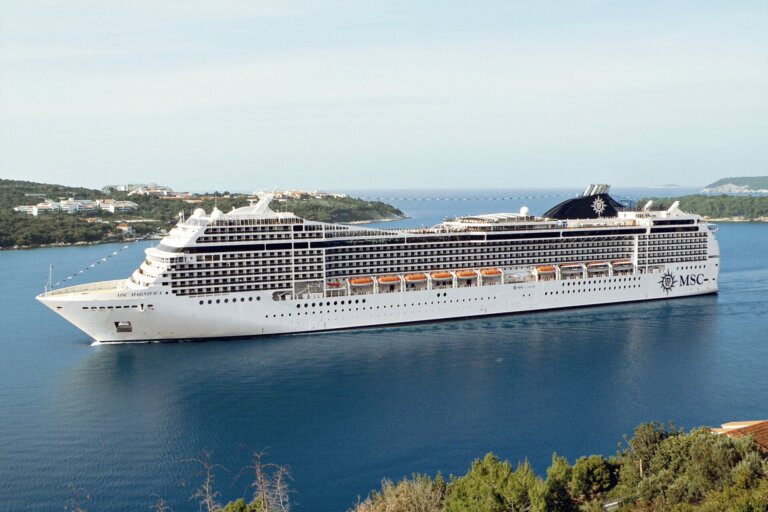
Arkitech’s software is now operating on twelve MSC Cruises ships, and the company expects to add more vessels soon. It is also exploring applications for ferries and river cruise ships and, in the longer term, vessels carrying refrigerated cargo, such as LNG tankers.
Climate Regulations
Huijer notes that by reducing energy use, the software also helps cruise lines comply with increasingly stringent IMO and EU environmental regulations, including CII ratings. Ships with poor ratings are required to improve their performance. “Installing competing hardware-based solutions can easily take a year or two before results are achieved. We can demonstrate savings within three months.”
Huijer acknowledges that the ship’s energy source remains fossil-based. “Our focus is on the demand side: how much energy is actually needed? If you reduce that demand, you’re still making a difference.”
Source: Originally published in Dutch by Schuttevaer on July 11, 2026. This English translation preserves the substance and quotations of the original article.